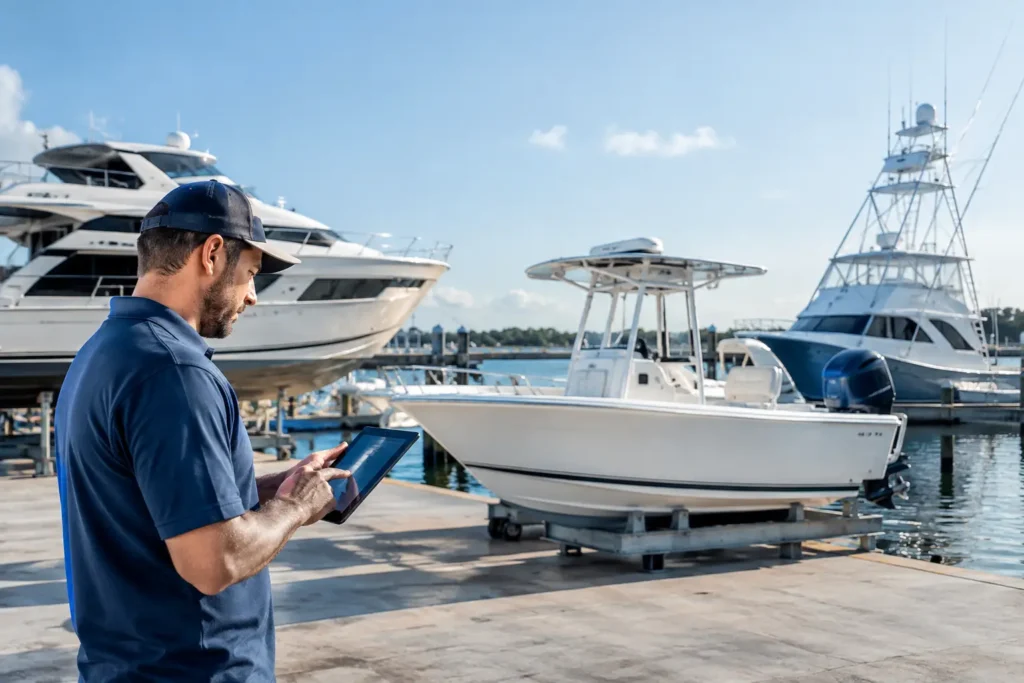
At 7:15 a.m., a marina manager may be handling a late transient arrival, a customer asking about a billing charge, a technician looking for a part, and a dockhand reporting a pedestal issue. Marina software should bring order to that reality. If it only works when someone is sitting at a desk with perfect information, it is not built for the dock.
The right system gives your team a live operational picture: who is in each slip, what work is open, what inventory is available, what the customer has approved, and what needs attention before it becomes a bigger problem. That is not about adding another dashboard. It is about keeping the marina moving when the phones are ringing, boats are arriving, and the weather is turning.
Marina Software Is an Operations Decision
A marina is part hospitality business, part property operation, part marine service center, and part emergency-response team. Every facility is different. A dry-stack operation has a different rhythm than a destination marina. A boatyard needs stronger work-order and yard-management discipline. A marina with an active service department needs tighter connections between customer records, technician time, parts, estimates, and invoicing.
That is why buying marina software by feature count alone is a mistake. A long list of modules does not help if your dock team cannot use the system on a phone, if service records live separately from vessel information, or if staff still have to re-enter the same information into accounting software at the end of the day.
Start with the actual handoffs that create friction. A boat owner calls in. A dockhand takes the request. A service manager assigns the job. A technician diagnoses the issue. Parts are pulled. The customer approves the work. The invoice goes out. If those steps happen in different systems, on scraps of paper, and through text messages, errors are not a possibility. They are part of the workflow.
Good marina software reduces those handoffs while preserving accountability. Everyone should know who entered the information, what changed, what was approved, and what remains open.
What Marina Software Must Handle at the Dock
The core job is simple: create one trusted record for each vessel, customer, job, and transaction. The details are where systems either help or get in the way.
Vessel and customer records need to be usable
A vessel record should be more than a name and phone number. Your team needs Hull ID information, engine details, equipment history, documents, service notes, photos, warranty information, and past spending available when the boat is in front of them. For larger operations, details such as berth location, electrical requirements, insurance documents, and seasonal instructions can matter just as much.
The record also needs to travel with the work. If a technician finds a corroded connection or a failing pump, that observation should be attached to the vessel and visible to the service manager without someone typing it again later.
Work orders must move from request to invoice
Service work is where a surprising amount of revenue and time can disappear. A verbal request becomes an informal task. A technician begins work without a clear scope. Parts leave the shelf without being assigned to the job. By month-end, someone is trying to reconstruct the story from memory.
A practical system creates jobs quickly, assigns labor, tracks technician time, captures photos and notes, applies parts, and carries the completed work into billing. The best workflow does not force technicians to act like data-entry clerks. It lets them speak, scan, photograph, and confirm while standing in the engine room or on the dock.
Inventory should reflect what is actually on the shelf
Marine inventory is expensive, varied, and frequently hard to substitute. A missing impeller, filter, anode, or specialized fitting can delay a job and frustrate a customer. Yet many facilities still rely on a spreadsheet that falls behind the moment a part is issued.
Barcode-based inventory workflows make a meaningful difference because they connect the physical part to the work order. That helps managers see stock levels, understand what jobs consumed, order before critical items run out, and avoid charging for parts that were never recorded. It also creates cleaner margins, which matters when parts costs and labor rates are under pressure.
Billing cannot be an afterthought
Your billing process should match your operating process. That includes slip or storage charges, service labor, parts, fuel, haul-out work, and other fees relevant to your facility. If accounting requires manual re-entry from work orders, the risk is not just wasted office time. It is delayed invoicing, missed charges, and records that do not agree.
For service-heavy operations, two-way QuickBooks synchronization can reduce duplicate data entry and keep financial records closer to real time. It still needs oversight. No integration can fix inaccurate labor entries, unapproved work, or parts that were not scanned out. Software improves the process, but the process has to be clear first.
Choose Marina Software Around Your Real Workflows
Before scheduling demos, walk through three or four common days at your operation. Use real examples, not idealized ones.
Consider a transient boat arriving after hours. Can the dock team find the reservation, confirm the assigned slip, see vessel details, record arrival notes, and communicate any issue without calling the office? Then consider a routine service request. Can it become a work order in minutes, with customer history and equipment details already attached? Finally, look at a complicated repair that requires diagnostics, special-order parts, multiple technicians, and customer approval. Can the system keep the entire job traceable from first symptom to final invoice?
Those scenarios reveal more than a polished demonstration ever will. They expose whether the platform understands the difference between a marina office and a working waterfront.
Questions to Ask Before You Commit
When evaluating marina software, ask direct questions that reflect the way your team operates:
- Can dockhands, technicians, and managers complete their key tasks from a phone or tablet?
- Does each vessel have a complete, searchable record that includes service history, documents, photos, and equipment information?
- Can staff convert a customer request into an assigned job without duplicate entry?
- Are labor, parts, estimates, approvals, and invoices connected in one workflow?
- Does inventory update when parts are issued to a job, and can staff scan items at the point of use?
- How does the system connect with the accounting tools your office already depends on?
- Can the provider show the exact workflow your team uses, not just generic screens?
The answer to every question will not be the same for every facility. A small marina may value simple customer records and billing above all else. A large boatyard may need detailed job costing, equipment history, technician accountability, and inventory control. The point is to buy for the work you do now, while leaving room for the work you plan to take on next season.
Adoption Is Where the Return Is Won
Even capable software fails when it is introduced as an office project that the dock and service teams must somehow absorb. Bring the people who create jobs, issue parts, move boats, and speak with customers into the process early. They know where information gets lost.
Roll out the system around one high-friction workflow first, such as service work orders or inventory issue-outs. Set a clear standard for what must be entered, who owns each step, and how exceptions are handled. Then review the data after a few weeks. Are jobs being closed faster? Are more parts reaching invoices? Are technicians spending less time chasing history? Are customers getting clearer updates?
That is the operational proof that matters. Adoption is not measured by logins. It is measured by fewer missed details, faster decisions, and records your team can trust.
Build for the Entire Marine Relationship
The strongest marine operations platforms recognize that the customer relationship does not begin and end with a billing statement. Boat owners want access to maintenance records, spending history, weather and tide information, and trusted providers. Service teams need clear jobs, diagnostics, inventory control, and accounting connections. Captains and crews need dependable records, checklists, watchkeeping tools, and coordination across the vessel.
Yacht Logic approaches this connected ecosystem from the water up, with mobile workflows designed around real vessel operations rather than generic office administration. That matters because the useful unit of work is not a spreadsheet row. It is a boat, a crew member, a customer request, a part in hand, and a decision that needs to be made before the day gets away from you.
Choose software that gives your people control where the work happens. When a dockhand can see the right vessel record, a technician can document the job immediately, and the office can invoice from trusted data, the marina runs with less chasing and more confidence.