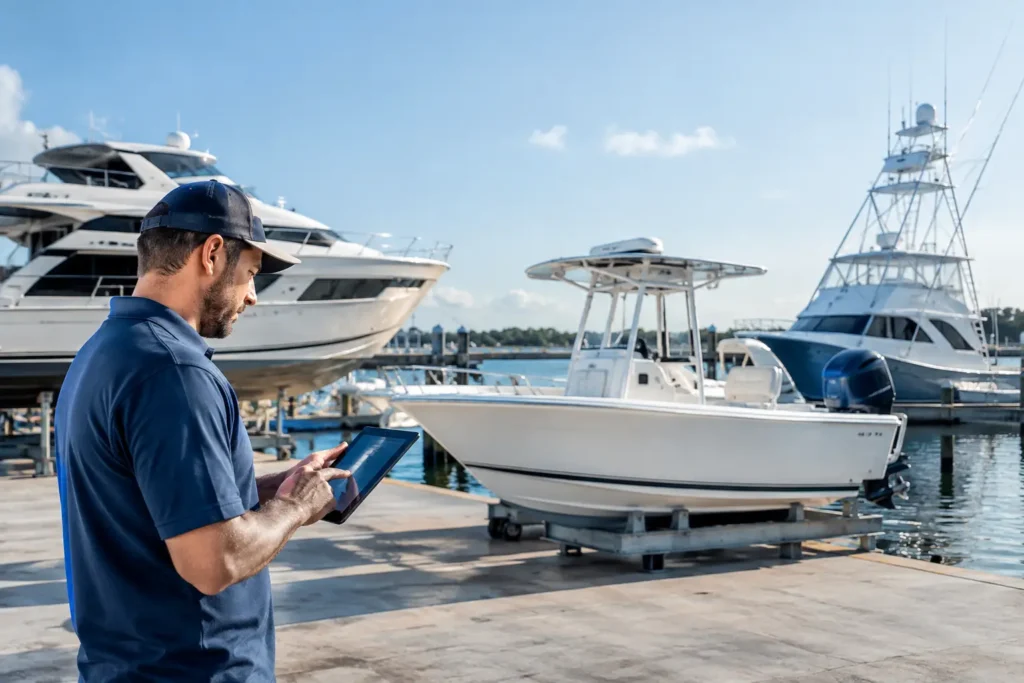
A failed bilge pump does not wait for a clean spreadsheet. It gets reported by text, mentioned over the radio, photographed in poor light, and handed to whoever is available at the dock. That is where marine AI earns its place: not as another dashboard to manage, but as a practical way to turn vessel information into action.
For boat owners, it can mean finding a service record before approving a repair. For a technician, it can mean turning a spoken work note into a complete job without returning to the office. For a captain and crew, it can mean preserving the small operational details that keep a demanding vessel running properly. The value is simple: less retyping, fewer missing records, and better decisions when time matters.
What Marine AI Should Actually Do
AI is often sold as a broad promise. On the water, broad promises do not help much. A useful system needs to understand the difference between an engine-hour service and a calendar-based inspection, between a hull identification number and a part number, and between an open work order and a completed repair awaiting approval.
The best marine AI tools start with the information people already produce during normal operations: photos of engine plates, voice notes from the dock, invoices, maintenance logs, fuel entries, checklist results, inventory scans, and equipment symptoms. The job is to convert those messy inputs into records that can be searched, assigned, tracked, and used again.
That does not mean AI replaces a capable mechanic, captain, or service manager. It removes the clerical drag around their judgment. A technician still diagnoses a cooling issue. AI can help capture the symptoms, identify the relevant asset, pull prior service history, and create a traceable record of what was done. That is a far more useful application than generic chat for chat’s sake.
From a Photo to a Usable Vessel Record
Marine equipment carries information everywhere, but it is rarely in the right place when needed. Engine plates, generator tags, pump labels, warranty documents, and distributor catalogues all contain details that should be tied to a specific boat and system.
Photo and document extraction can turn that information into organized data. Instead of manually entering serial numbers from a blurry image or filing a PDF where no one can find it later, the system can identify key fields and attach them to the relevant vessel record. A human should still verify critical numbers, especially for parts ordering or warranty work. But verification is much faster than starting from a blank screen.
For an owner, this creates a cleaner history of what is onboard. For a service business, it reduces the chance of ordering against the wrong model or sending a technician out without the right context. For a crew, it creates continuity when a new engineer, stew, or relief captain needs to understand the vessel quickly.
Voice Notes Belong in the Workflow
Dockside work is hands-on. People are carrying tools, opening hatches, handling lines, and moving between vessels. Asking them to stop and type a perfect job description is how details get lost.
A practical AI workflow lets a user speak naturally: “Port generator showing intermittent high-temp alarm after forty minutes under load.” That note can become a job with a timestamp, vessel, system, symptom, and next step. The service manager can review it, assign it, and keep the conversation attached to the work instead of scattered across text messages.
There is a trade-off here. Voice capture is fast, but noisy engine rooms and vague language can produce bad inputs. The solution is not to abandon voice notes. It is to give users a quick review step and build the workflow around marine terminology, assets, and common service patterns. Fast data is only valuable when it stays trustworthy.
Marine AI for Owners, Shops, and Crews
The same technology should not look identical for every user. A 24-foot center console, a busy repair shop, and a 145-foot yacht have different operating pressures. The common need is control over information, but the workflow changes.
Recreational boat owners: fewer surprises, better records
Most owners do not need a complex maintenance system. They need one reliable place for receipts, service records, documents, costs, weather, tides, and reminders. When a mechanic asks what was done last season, the answer should not depend on finding an old email or remembering which shop handled the work.
AI can help organize records as they arrive, identify document details, and make past maintenance easier to retrieve. It can also help owners describe a problem clearly before they call for service. A better service request saves time on both sides and gives the provider useful context before arriving at the boat.
The limit is equally clear: an app cannot inspect a corroded connection or hear a bearing failing through a phone speaker with the certainty of an experienced professional. Owners should treat AI as a recordkeeper and first-pass assistant, not a substitute for proper diagnosis.
Marine service businesses: less paperwork between jobs
For service companies, the biggest gain often happens between the wrench and the invoice. Job creation, technician time, parts usage, customer approvals, and billing details are frequently captured in different places, if they are captured at all. That creates delays, disputed invoices, and margin that quietly disappears.
AI-supported workflows can turn field activity into operational data while the technician is still at the vessel. A photo of a part, a barcode scan, a dictated service note, and a time entry can all feed the same job record. When inventory, labor, and job status stay connected, office staff do not have to reconstruct the day after the fact.
This matters even more when QuickBooks synchronization is involved. Two-way accounting sync can reduce duplicate entry, but it only works if the source data is accurate. Clean technician workflows come first. AI helps by making those workflows easier to complete in the field, not by masking bad process behind automation.
Captains and crew: operational continuity without the paper chase
Large-yacht operations run on details. Watchkeeping notes, guest preferences, safety checks, provisioning, fuel logs, maintenance tasks, and handovers all need to be current and accessible. A crew member should not have to search through separate chats, binders, and spreadsheets to find an operating procedure or confirm whether a task was completed.
AI can help structure those recurring records and surface the right information at the right moment. It can turn a watch note into an organized handover item, help create a checklist from a repeatable procedure, or make a prior preference easy to find before guests arrive. Used properly, it supports consistency without adding another layer of admin to an already demanding operation.
The Real Test Is Whether It Works Offline From a Desk
Marine technology has a history of looking good in a conference room and falling apart at the dock. If a system assumes perfect Wi-Fi, clean hands, unlimited time, and a staff member sitting at a desktop, it is not built for real vessel operations.
The practical test is straightforward. Can a technician update a job from a phone in an engine room? Can a captain find a document while underway? Can a boat owner retrieve a prior invoice before calling a service provider? Can a manager see what happened without chasing three people for status?
Tools built from the water up answer those questions before adding features. Yacht Logic AI follows that captain-built approach by connecting boat records, field service operations, and crew workflows around the information that vessels generate every day. The point is not to make boating feel more technological. It is to make the work around boating feel less fragmented.
Start With One Friction Point
The strongest AI rollout is rarely the biggest one. Start where information currently disappears or gets entered twice. That might be technician time tracking, receipt capture, inventory usage, work-order notes, or vessel documents. Measure whether the new workflow actually saves time and produces records people trust.
Then expand from there. AI becomes valuable when it is part of the habit of running a boat, servicing a customer, or handing over a watch. The next time someone says, “I know we did this before, but I cannot find the details,” the right system should already have the answer waiting.