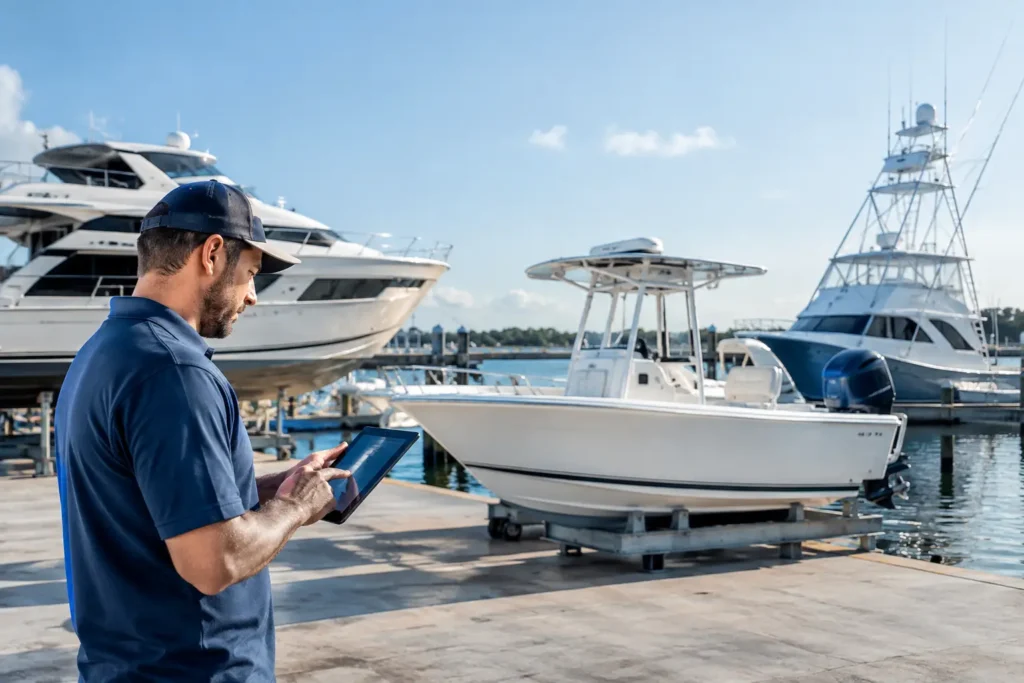
A customer calls at 7:15 a.m. with an engine alarm. A technician is already headed to another slip. The part may be on a shelf, on a truck, or still sitting in a distributor cart. That is where marine repair software earns its keep: not in a conference room, but at the dock, with wet hands, limited signal, and a customer waiting for a clear answer.
For marine service businesses, the problem is rarely a lack of work. It is the gap between the work performed and the information needed to schedule it, document it, bill it, and support the vessel after it leaves the yard. Paper work orders, text-message estimates, handwritten timecards, and a parts count that lives in someone’s head create that gap. Good software closes it without asking the crew to become office administrators.
What Marine Repair Software Should Actually Solve
Generic field-service platforms can manage a calendar and send an invoice. Marine work needs more context. Boats have Hull IDs, engine serial numbers, generator hours, multiple systems, intermittent faults, seasonal service histories, and owners who may be hundreds of miles away when the issue occurs.
The right platform gives the team one operating record for each vessel. A service writer should be able to pull up prior jobs, photos, recommendations, engine plates, warranty notes, and open estimates before calling the owner back. A technician should be able to see the job scope on a phone, clock in, add findings, capture photos, and record parts without returning to the office to translate notes.
That does not mean every shop needs every feature on day one. A two-person mobile mechanic operation may care most about job creation, technician time, estimates, and invoicing. A boatyard with several departments may need work orders tied to storage, hauling, subcontractors, inventory, and purchase orders. The software should fit the operation you run now while giving you room to add control as volume grows.
Start With the Work Order, Not the Dashboard
A clean dashboard is useful, but it will not fix a messy intake process. The work order is the operational center of a marine repair business. If the vessel, customer concern, requested service, assigned technician, labor, parts, and approvals are scattered across different tools, the team will spend the day chasing information.
A useful work order starts with a vessel profile. That profile should hold the basics, including owner contact details, make and model, Hull ID, propulsion and generator information, equipment serial numbers, and service history. When a recurring issue returns – a battery charging fault, a raw-water flow alarm, a generator that only stalls under load – the technician can see what was previously checked instead of beginning from zero.
From there, the system should turn a call, a spoken note, or a customer message into an actionable job. The description needs to be clear enough for dispatch and flexible enough for the technician to document what is actually found. Marine repairs often change once panels come off or the vessel is under load. Software should preserve the original customer complaint while making scope changes, photos, and approvals traceable.
That traceability protects both sides. The owner can see why the repair changed. The business can show what was recommended, what was approved, and what was declined. Months later, nobody is relying on memory or trying to interpret a faded carbon copy.
Mobile use is not optional
A technician should not have to wait until the end of the day to enter time and notes. End-of-day data entry is where billable time disappears, job details get shortened, and parts used from the truck never make it onto the invoice.
Dockside workflows need to be fast. Clock into the right job. Scan or search a part. Add a photo of the corroded connection, failed impeller, or diagnostic reading. Record the completed work and move to the next call. The fewer taps required, the more likely the record will be accurate.
Mobile-first does not mean a phone replaces a proper office view. Service managers still need a larger screen for dispatch, workload planning, estimates, and reporting. It means the system respects where the work happens. Built from the water up, the field view and the office view should work from the same information.
Time, Parts, and Billing Must Stay Connected
Most margin problems are not caused by one dramatic mistake. They come from small leaks: 20 unrecorded minutes here, a shop-supply charge there, a part pulled from inventory but never billed, or an invoice held up because someone has to decipher a technician’s notes.
Marine repair software should connect the technician’s time entry to the job, the job to the estimate, and the completed work to the invoice. That gives the service manager a real view of labor consumed versus labor sold. It also makes it easier to spot jobs that routinely exceed estimate, technicians who need more diagnostic support, or service packages that are priced too tightly.
Parts control matters just as much. A barcode-based inventory process can reduce the guesswork around what was installed and what remains on hand. When a technician scans a part onto a work order, the business has a better record for billing, reordering, warranty support, and future service history.
There is a trade-off here. A full inventory system requires discipline. Bin locations must be set, receipts must be recorded, and technicians need a practical way to account for truck stock. For a small operation with low parts volume, starting with job-level parts capture may be smarter than attempting a full warehouse rollout immediately. The goal is better control, not creating a new chore that the crew avoids.
Accounting should follow the work
Accounting software is where many businesses discover whether their field process is really working. If office staff must manually re-enter customers, invoices, payments, and parts after every job, errors and delays are guaranteed.
Two-way QuickBooks sync can reduce duplicate entry when it is configured around a clear workflow. Decide which system owns customer records, how labor and parts map to accounts, when invoices transfer, and who resolves exceptions. Sync alone is not a strategy. The value comes from defining the handoff so completed work becomes accurate financial data without a second round of typing.
AI Has a Job to Do, Not a Role to Play
Marine businesses do not need AI for the sake of saying they use AI. They need help turning unstructured dockside information into usable records.
A technician may dictate, “Port engine overheating at cruise, found restricted seawater flow, replaced impeller, flushed intake, sea trial completed.” AI can help convert that spoken update into organized work notes, suggested labor descriptions, and a customer-ready explanation. A photo of an engine plate can become equipment details in the vessel record. A customer symptom can prompt diagnostic checklists that give a less experienced technician a stronger starting point.
That is practical AI: less typing, fewer missed details, and better records. It should not pretend to replace skilled diagnosis. A damaged hose, a cooling-system restriction, or an intermittent electrical fault still requires a trained person who understands the vessel, the equipment, and the safety implications. The software can surface history and guide the next check. The technician makes the call.
For larger operations, this same approach supports consistency across the team. Standard checklists for commissioning, haul-out inspections, generator service, and delivery preparation help ensure critical steps are documented. They are especially useful when multiple technicians touch the same vessel or when a captain needs a clear record before guests arrive.
Choose Software Around Your Real Operating Friction
Before scheduling demonstrations, identify where work breaks down in your business. Is it slow quote turnaround? Missing technician time? Parts that disappear from the shelf? Invoices that sit for a week? Repeat visits because prior findings were buried in text messages? Your answer should shape what you evaluate.
Ask to see a complete job cycle, not just a polished screen. Can the system create a vessel record, open a job, dispatch a technician, capture time and parts on a phone, request approval, close the work, and send the result to accounting? Can a manager find the service history six months later? Can it handle the difference between a scheduled 100-hour service and a no-start call that turns into a full diagnostic?
Also look at adoption. Software only improves operations when the people at the dock use it. If technicians need lengthy training to enter a basic job note, or if the process adds steps without removing paperwork, the team will revert to texts and notebooks. The best marine systems make the right action easier than the old workaround.
Yacht Logic Pro is designed around that reality: a connected operating system for marine service teams that need job creation, mobile time tracking, inventory control, service records, and accounting workflows to move with the vessel instead of staying trapped at a desk.
A better process does not require a perfect digital transformation on Monday morning. Start with the jobs that create the most confusion or margin loss. Build reliable vessel records. Get time captured while the work is happening. Then let each completed job leave behind a record that makes the next service call faster, clearer, and easier to trust.