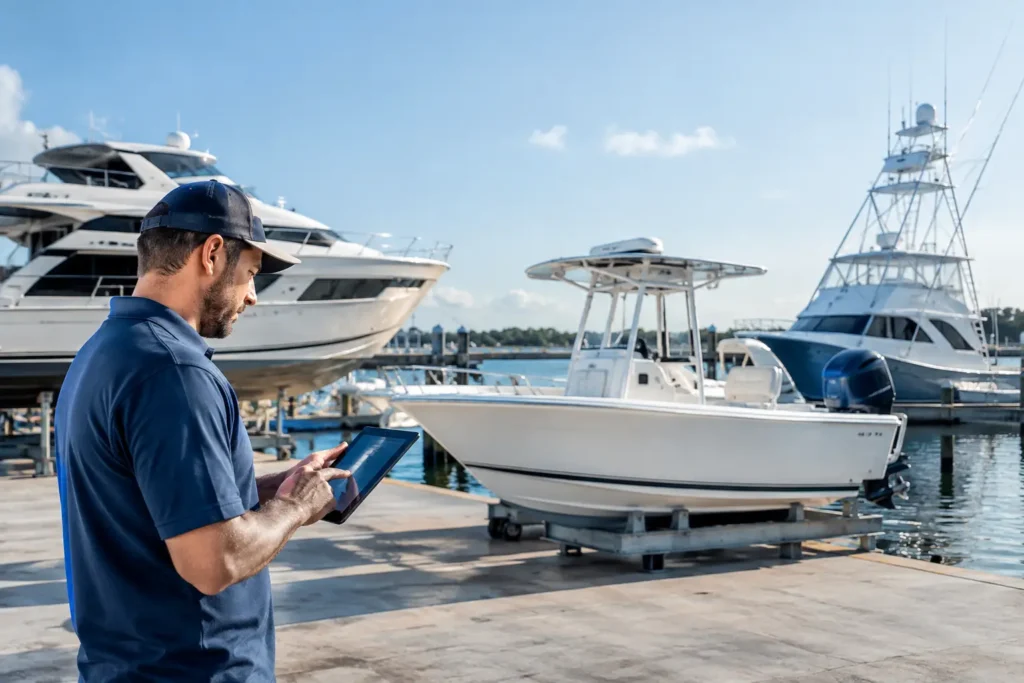
A work order that gets wet on the swim platform, rides around in a technician’s truck, or sits under a stack of invoices is not a record system. It is a risk waiting to become a billing dispute, missed maintenance item, or frustrated boat owner. The real question behind paper work orders vs apps is not whether your team likes paper. It is whether your operation can afford to lose visibility once the job leaves the office.
Paper has earned its place in marine service. It works without a signal, requires no training, and can be handed to a technician in seconds. But boats are mobile, jobs change at the dock, and the details that matter most rarely stay in one place. For service companies, boatyards, marinas, captains, and owners, the better workflow is the one that keeps the record accurate from first call to final invoice.
Why paper still survives in marine operations
Paper work orders are familiar because they match the way many marine businesses grew: a phone call comes in, someone writes down the problem, a mechanic heads to the boat, and the office sorts out the details later. On a small job with one technician and one clear repair, that process can appear perfectly adequate.
Paper also has a legitimate advantage in rough conditions. A clipboard does not need a login. A printed checklist can be marked up in an engine room with dirty hands. When a technician is working offshore or in a marina with weak coverage, a physical page may feel like the dependable choice.
The trouble starts when the work order needs to do more than describe the work. A marine service ticket often needs the vessel name, Hull ID, owner contact details, engine hours, equipment serial numbers, labor time, parts used, photos, technician notes, customer approval, and an invoice-ready summary. That information may be gathered across several days, by more than one person, in different locations.
Paper is not bad because it is paper. It is limited because it creates a handoff problem every time information changes hands. Someone has to read handwriting, re-enter notes, locate the right invoice, confirm what parts were actually installed, and call the technician to fill in the blanks. The job may be done, but the operation is still chasing the record.
Paper work orders vs apps: where the difference shows up
The biggest difference between paper work orders and mobile apps is not the screen. It is the flow of information.
With paper, the office creates a ticket and the field team completes it. With a purpose-built marine app, the work order becomes a live operational record. The service writer, technician, parts manager, captain, and owner can each contribute the information they need, when they have it, without rebuilding the job from scratch at every stage.
Consider a common dockside call: a customer reports that the port engine is running hot. A paper ticket may say, “Check overheating issue.” That leaves the technician to locate the boat, ask for more context, diagnose the issue, write down parts, track time separately, and return the paper to the office.
A mobile work order can begin with the vessel profile already attached. The service writer can include the engine details, prior work history, customer photos, berth location, and reported symptoms. The technician can add diagnostic notes, log time as work happens, capture photos of the failed impeller or clogged strainer, and record the parts pulled from inventory. The office sees the job progress without waiting for a stack of paperwork at the end of the day.
That is not technology for technology’s sake. It prevents the expensive gaps between what happened on the boat and what gets billed, scheduled, ordered, or documented later.
What apps improve on the dock
A good app should not turn a simple repair into a software project. It should remove repeat work and make the field workflow easier than the clipboard. For marine operations, that usually means four practical gains:
- Faster job creation: A spoken request, customer message, or photo can be turned into a usable work order without retyping the same vessel and customer information.
- Accurate labor capture: Technicians can start, pause, and complete time from the dock, rather than trying to reconstruct a full day from memory.
- Better parts control: Barcode scanning and inventory records connect the part used on the boat to the part removed from stock.
- Complete proof of work: Photos, notes, checklists, and signatures stay with the job record, making approvals and follow-up far easier.
For boat owners, the value is just as clear. Instead of a loose receipt and a vague note that says “service completed,” they have an organized maintenance history. That matters when troubleshooting a recurring issue, planning a refit, managing warranty work, or selling the vessel.
For a captain or yacht crew, the same principle applies at a larger scale. A work order may involve watchkeeping observations, contractor access, guest-impact timing, spare parts, and systems that cannot be taken offline during a busy program. A live record gives the team continuity between shifts and keeps critical details from getting buried in a notebook or text thread.
Where paper still makes sense
Going digital does not mean banning every printed form on the property. There are situations where paper remains useful: emergency checklists, temporary field notes, backup forms during an outage, or a quick inspection sheet for a subcontractor who is not part of your system.
The key is to treat paper as a backup or capture tool, not the final source of truth. If the inspection sheet never makes it into the vessel record, it cannot help the next technician. If labor hours remain on a handwritten ticket until Friday, they cannot support real-time scheduling or accurate invoicing.
This is where many businesses get stuck. They buy software but continue operating as though the paper ticket is primary. The technician writes everything down first, then someone in the office enters it later. That creates double entry, delays, and resistance from the people doing the actual work.
A better approach is mobile-first: let the technician complete the record where the work happens. Paper can still be available when conditions demand it, but the system should make it easy to capture the information once and use it everywhere else.
The cost is not just the price of paper
A printed work order costs very little. The hidden cost arrives after the technician leaves the dock.
Missed labor is one of the most common leaks. A technician spends 20 minutes finding the boat, discussing a problem with the owner, locating a part, or documenting a repair. If that time is not captured, the company absorbs it. Multiply that across several technicians and a busy season, and the “simple” paper process becomes costly.
Then there is the cost of incomplete history. A different mechanic gets called back to the same boat six months later and cannot see what was diagnosed, replaced, or recommended. The owner repeats the story. The technician starts over. The company looks less organized than it is.
Inventory is another pressure point. When parts are written down late, stock counts drift. A team may order an item already sitting on a shelf, or promise a repair before discovering a critical part is unavailable. Apps with dockside inventory workflows help connect the physical part, the job, and the accounting record while the facts are still fresh.
For businesses using accounting software, the strongest setup reduces duplicate entry. The service record should support the invoice, not force the office to build the invoice from scratch after every job. Two-way QuickBooks sync can be meaningful here, but only if the work order data is clean before it reaches the books.
Choosing an app that fits marine work
Not every field-service app understands a boat. Generic software may handle appointments and invoices, yet struggle with vessel-specific records, engine plates, multiple onboard systems, variable marina access, or the need to work from a phone with wet hands and limited time.
Look for a system that follows the way your crew already works. It should support vessel profiles, mobile job updates, technician time tracking, photos, parts and inventory, customer approvals, and clear job status. It should also make historical records easy to find when a customer says, “You worked on this last season.”
The rollout matters as much as the feature list. Start with one workflow that causes regular friction, such as repair tickets, scheduled maintenance, or labor capture. Build a simple process around it, train the people who use it dockside, and listen to where the workflow slows them down. A system only creates control if the crew trusts it enough to use it in real conditions.
Yacht Logic Pro was built from the water up for this reality: turning jobs, technician updates, parts activity, and vessel records into one connected operational picture rather than another desk-bound admin task.
The right answer is the one your team can run every day
For a one-off repair in a remote location, a paper form may be the fastest tool available. For a growing service department, a busy boatyard, or a yacht team managing complex maintenance, paper alone eventually creates too many blind spots.
The shift from paper to apps is not about making marine work feel more corporate. It is about giving the people closest to the vessel a faster way to capture what they know, while giving everyone else a record they can trust. Start with the next work order that would be painful to lose, repeat, or explain weeks later. That is usually the job that tells you what your process needs most.