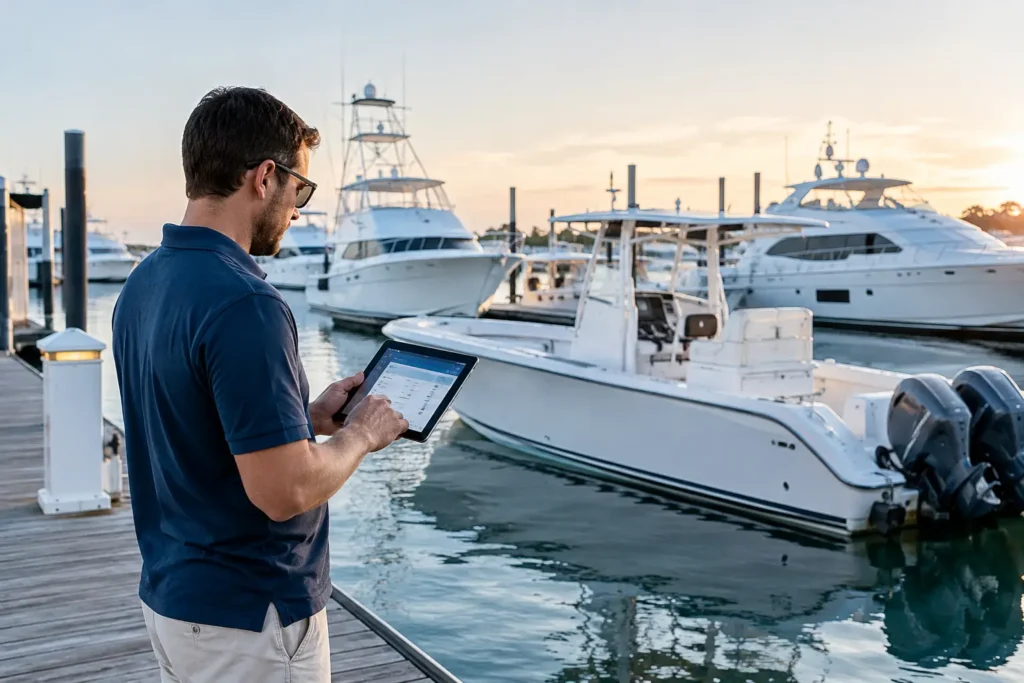
A boat app vs paper logs decision usually gets made at the worst possible moment: a technician asks when the impeller was last changed, an insurer wants documentation, or you are trying to remember which filter was installed before a long run. The answer should not depend on a faded notebook living under the helm seat.
Paper logs have earned their place aboard. They work without a battery, signal, subscription, or learning curve. But boats create more moving parts than a single notebook can comfortably hold: service invoices, engine hours, photos, warranties, fuel records, registration documents, seasonal checklists, and notes from the last person who touched the boat. The better choice depends on what you need the record to do after you write it down.
Boat App vs Paper Logs: The Real Difference
A paper log captures information. A boat app can capture, organize, find, and act on it.
That distinction matters when ownership gets busy. Writing “changed oil at 742 hours” in a logbook is better than relying on memory. Recording the date, engine hours, oil type, filter part number, receipt, technician, cost, and the next service interval creates a maintenance history you can use. When the next service is due, the record is already where you need it.
For a recreational owner, that may mean avoiding duplicate work or being able to answer a service provider’s questions from the dock. For a captain, it can mean handing over a clean and traceable vessel history. For a marine business, it means fewer calls to the office asking someone to find paperwork from last season.
The point is not to replace common sense with a screen. It is to stop making good people hunt for information that should take seconds to retrieve.
Where Paper Logs Still Win
Paper is tough in a way software cannot be. A waterproof notebook and a pencil are available when electronics are charging, wet, broken, or otherwise having a bad day. On a small center console, a simple handwritten pre-departure note or fuel entry may be all the recordkeeping an owner needs.
Paper also works well for immediate operational notes. Crew can jot down an engine-room reading, a watchkeeping observation, or a quick punch-list item without opening an app, logging in, or navigating a menu. In rough weather, simple is often the right answer.
There is also a human factor. Some owners genuinely keep better records when they write by hand. A perfect digital system that never gets updated is less useful than a notebook used consistently.
The downside shows up later. Paper is difficult to search, easy to misplace, and nearly impossible to share cleanly. It does not remind you that a service interval is approaching. It cannot attach a photo of a leaking fitting or pull an invoice alongside the maintenance note. And if a notebook goes overboard, it has a very short recovery window.
Where Boat Apps Earn Their Keep
A well-built boat app is not just a digital logbook. It becomes the operating file for the vessel.
The strongest benefit is centralization. Instead of storing records in a glovebox, a phone photo library, three email threads, and a desktop folder nobody can find, the information stays connected to the boat. Hull ID, engine details, documents, service history, maintenance costs, and images all have a home.
That becomes especially valuable at handoff points. A spouse needs to deal with a mechanic. A captain is joining the program. A boat is going on the market. A new owner asks for records. With organized digital history, the vessel is easier to understand and easier to maintain.
Modern mobile tools also reduce the friction of making an entry. Take a photo of an invoice, speak a note after a fuel stop, scan a barcode, or record a symptom while you are standing beside the engine. Those small actions are more likely to happen than a promise to update the logbook later at home. We all know how that promise usually goes.
For service professionals, the gains compound. Mobile job creation, technician time tracking, parts usage, checklists, photos, and customer approvals can be tied to the same work order. That cuts down on transcription errors and gives both the shop and boat owner a cleaner record of what was done.
Reliability Is Not Just About Going Offline
The usual objection to an app is fair: what happens when there is no cell service?
A marine record system should not assume you have a perfect connection at the fuel dock, in the yard, or offshore. Offline access and later synchronization matter. So does keeping critical documents available on the device and maintaining reasonable backups. Before choosing any platform, ask exactly what can be viewed and entered without service, and how information is protected if a phone is lost or replaced.
But paper has reliability issues too. Water, mildew, sun, theft, and simple human misfiling are not rare events on boats. A paper log can be physically reliable while still being operationally unreliable because no one can locate the one entry that matters.
The most dependable setup is often a hybrid. Keep a small paper notebook for immediate watch notes, departure checks, or emergency use. Use the app as the permanent system of record for maintenance, documents, costs, photos, and service history. Paper handles the moment. Digital handles the lifetime of the boat.
Cost Control Starts With Better Records
Maintenance costs do not get expensive only because parts cost money. They get expensive when work is repeated, warranty information disappears, small issues are ignored, or owners approve service without a usable history.
A paper log can track spending, but it takes discipline to total it, compare seasons, or spot a pattern. A digital record can show what has been spent on a system over time and preserve the receipts behind the number. That is useful when deciding whether to repair, replace, or get a second opinion.
Consider a recurring cooling issue. With scattered notes, each technician starts from scratch. With dated service entries, photos, prior diagnostics, replaced components, and engine hours, the conversation starts farther down the field. The result may still be a complex repair, but at least you are not paying repeatedly to rediscover the same facts.
For owners who sell or trade boats, complete records can also support confidence in the vessel. A clean history does not guarantee a higher sale price, but missing documentation creates questions. Questions tend to cost money.
What Different Boats Actually Need
Not every boat needs the same system. A trailer-boat owner who runs 50 hours a year may only need maintenance reminders, key documents, and a simple cost history. A cruising boat needs stronger document storage, systems records, fuel tracking, and service details that can travel with the vessel.
A charter operation, marina, or service shop has a different standard. There, records need to move between people without becoming a stack of texts and handwritten work orders. Technicians need to enter time and parts dockside. Managers need visibility into open jobs, inventory, billing, and customer communication. Large-yacht crews may need watchkeeping, guest preferences, planned maintenance, fuel logs, and clear handover notes across rotating crew.
This is why generic office software often feels awkward around boats. The work happens in engine rooms, at docks, in yards, and on the move. Tools need to be built from the water up, not adapted from a conference room.
How to Choose a System You Will Use
Choose based on your actual habits, not an ideal version of yourself. If a system takes too many taps to record an oil change, it will eventually be skipped. If it cannot store a receipt, photo, and service note together, it will create more work than it removes.
Look for a practical way to organize vessel details, maintenance schedules, costs, documents, and service contacts. Make sure records can be exported or shared when needed. If multiple people touch the boat, confirm that access and handoffs are straightforward. And do not overlook the basics: easy search, clear dates, engine-hour fields, photo attachments, and offline capability.
Yacht Logic Connect is designed around this kind of real-world ownership, giving boaters a free way to keep records, maintenance costs, weather, tides, and service information in one place without turning routine boat care into another office job.
Keep the Log, Lose the Loose Ends
There is no rule saying a proper captain must use paper, or that every owner needs to manage a boat from a phone. A handwritten log remains a smart backup and a useful tool aboard. But when records affect maintenance decisions, service bills, resale confidence, or crew handovers, a searchable digital system carries more of the load.
Start with one habit: log the next service, fuel stop, repair, or equipment change while the details are still fresh. Whether you write it down, enter it digitally, or do both, the useful record is the one your future self can find before the next problem starts.