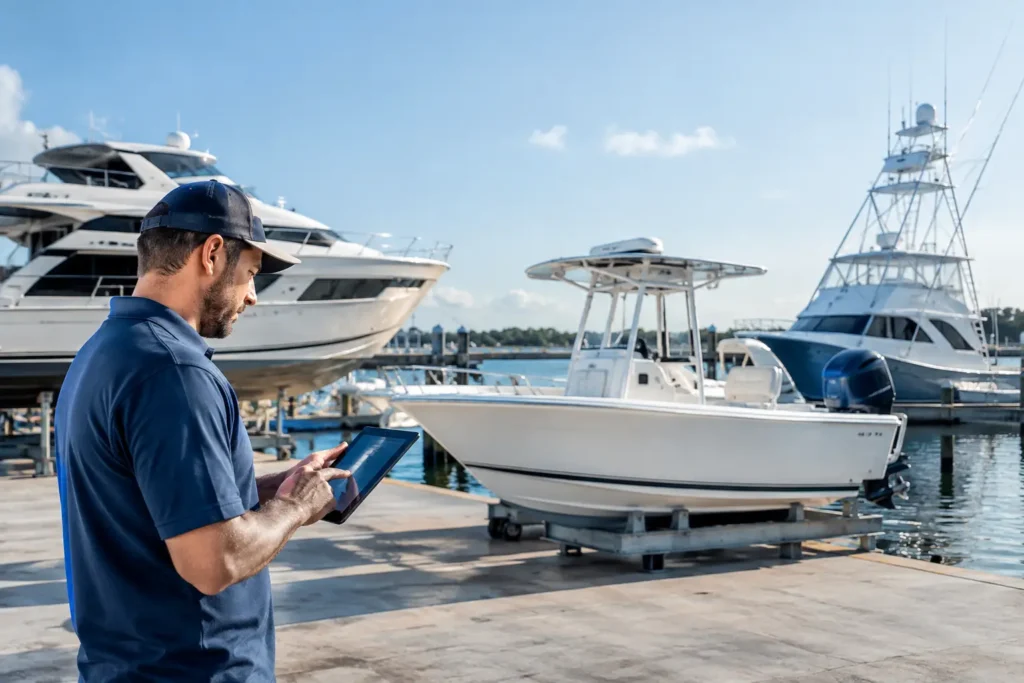
A boat’s Hull Identification Number is easy to ignore until a title transfer, insurance quote, service record, theft concern, or survey brings everything to a stop. Then one wrong character can turn a routine task into a dockside scavenger hunt. If you need to find boat hull identification number details, start at the hull itself – not an old registration card, a listing, or someone’s memory.
The HIN is the vessel’s permanent identity. It connects the physical boat to its title, registration, manufacturer records, warranty information, accident history, and in many cases, its resale value. Built from the water up, the practical approach is simple: locate it, photograph it clearly, compare it to your paperwork, and save it where your boat records actually live.
Where to find a boat hull identification number
For most recreational boats built for the U.S. market, the primary HIN is molded, stamped, engraved, or permanently attached on the starboard side of the transom. Look near the upper right corner when standing behind the boat and facing forward.
Federal placement requirements generally put it within two inches of the top of the transom, gunwale, or hull-deck joint – whichever is lowest. On many fiberglass boats, it is molded directly into the gelcoat. On aluminum boats, it may be stamped into the metal or displayed on a permanently attached plate. On pontoon boats, look on the aft starboard pontoon or near the stern structure.
That standard location covers a lot of boats, but not all of them. If the vessel has no conventional transom, or putting the HIN there is impractical, check the starboard outboard side of the hull within one foot of the stern. Personal watercraft often carry the number on the rear deck, aft hull, or near the swim platform. Sailboats may have it at the starboard transom, beneath a molded lip, or close to the hull-deck joint.
Paint, bottom growth, dock rash, old decals, aftermarket swim platforms, and years of repair work can hide the number. Wash the area first. Use a flashlight at a shallow angle to make shallow molded characters stand out. A phone photo with the flash off can sometimes read better than the naked eye, especially on faded gelcoat.
Do not grind, sand, scrape deeply, or remove a plate to expose a HIN. A damaged number creates a bigger documentation problem than a dirty one.
Look for the secondary HIN only when needed
Most boats also have a second, concealed HIN placed by the manufacturer in an unexposed area. It is intended to help identify a vessel if the visible number has been removed or altered. Its exact location is not normally published, and it varies by builder and model.
If you are a buyer, owner, surveyor, or service professional dealing with a questionable HIN, do not start pulling panels apart. Contact the manufacturer if it still exists, your state boating agency, or law enforcement. An authorized inspector can determine the correct next step without compromising evidence or damaging the boat.
What the 12-character HIN tells you
Most boats manufactured on or after August 1, 1984 have a 12-character HIN. It is not a random serial number. Each segment gives you a useful check against the boat and its paperwork.
The first three characters are the Manufacturer Identification Code, or MIC. This identifies the builder or importer assigned to that boat. The next five characters are the manufacturer’s serial number. The final four characters identify the date of certification and model year under the standard HIN format.
A typical number may look like this: `ABC12345D404`.
In that example, `ABC` is the manufacturer code, `12345` is the production serial number, `D4` indicates the month and year of certification, and `04` is the model year. The letter used in the date portion generally corresponds to a month, with A representing January and L representing December.
Older boats can be different. Boats built before the standardized 12-character format may have an earlier HIN arrangement, and some very old, homemade, or imported vessels may require state-assigned identification. Do not assume a number is fake just because it does not match the current layout. Confirm the boat’s build year and follow the rules in the state where it is titled or registered.
A HIN also is not the same as a state registration number. Registration numbers are typically displayed on both forward sides of the boat and can change when ownership or state registration changes. A U.S. Coast Guard documented vessel also has an official documentation number, usually displayed inside the boat. Those numbers serve different purposes. The HIN stays with the hull.
Compare the HIN before you buy, title, or service the boat
Reading the number is only half the job. Every character must match the title, registration, insurance documents, purchase agreement, and manufacturer information. Treat an `O` and a `0`, an `I` and a `1`, or a `S` and a `5` as potential trouble until you verify them. Faded characters and handwritten paperwork create mistakes all the time.
For a pre-purchase inspection, photograph the HIN in place and retain the original image. Compare it to every document while you are still at the boat. If the boat is on a trailer, check that the trailer VIN matches its title too. A clean boat deal can still become expensive when vessel and trailer paperwork are mixed up.
For marine service businesses, recording the HIN at intake protects both the shop and the owner. It confirms which vessel received the work, prevents duplicate customer profiles, and gives technicians a reliable reference when similar boats share a marina slip. It also makes it easier to connect service history, engine information, parts, photos, and invoices to the correct hull rather than to a nickname like “Sea Ray at Dock C.”
This is where centralized records earn their keep. A boat-management system such as Yacht Logic Connect can store the HIN alongside documents, maintenance costs, equipment details, and service history, so the number is available when an insurer, yard, or technician asks for it.
What to do if the HIN is missing, damaged, or does not match
A missing or altered HIN is not something to work around with a handwritten note. It can affect title transfers, insurance coverage, financing, theft investigations, and the boat’s ability to be registered. The right response depends on why the number is missing and what your state requires.
Start by checking for innocent explanations. A transom replacement, major fiberglass repair, repaint, or aftermarket bracket installation may have covered or damaged the original marking. Ask for repair invoices, prior photos, old surveys, and ownership records. If the boat was built by an individual, the state may have issued a HIN during registration.
If there is any sign the number was deliberately removed, ground off, overwritten, or does not match the paperwork, pause the transaction. Do not accept verbal assurances, and do not try to restamp the hull yourself. Contact your state boating or titling agency. In Florida, the Florida Fish and Wildlife Conservation Commission and county tax collector offices can direct owners toward the proper inspection and title process. Other states have their own vessel-title procedures.
An authorized inspection may be required before a state issues a replacement or assigned HIN. Expect to provide proof of ownership, bills of sale, prior registration or title documents, photographs, and possibly a builder’s statement for a homemade vessel. The state will tell you how and where to permanently affix the assigned number.
Make the HIN part of normal boat operations
The best time to document a HIN is before there is a problem. Add a clear photo of the number to your boat file, along with the title, registration, insurance declaration, engine serial numbers, trailer VIN, and a few current hull photos. Update those records after a sale, major repair, repower, or change in registration.
For captains and crew, verify the HIN when taking over a new vessel or organizing a refit file. For yards and mobile technicians, confirm it at the first work order and use it consistently. Small habits like this reduce disputed invoices, wrong-part orders, delayed surveys, and paperwork that goes missing when the boat changes hands.
Your boat may have a name, a slip number, and a story everyone at the marina knows. Its HIN is what keeps that story tied to the right hull. Capture it clearly now, and the next title transfer, service call, or insurance request stays where it belongs – routine.