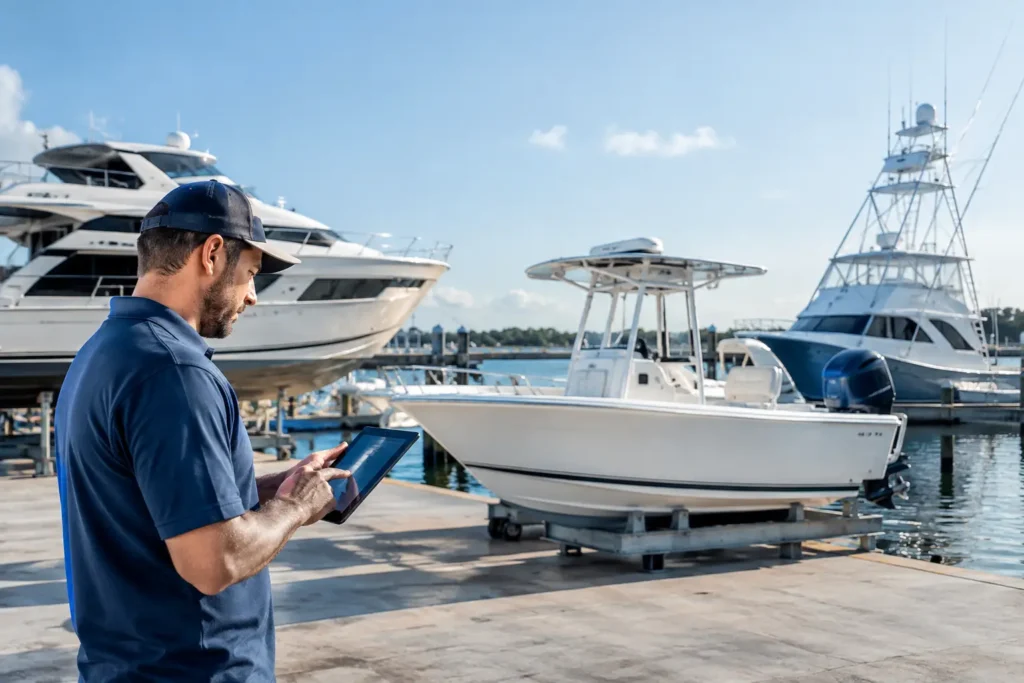
A technician has the boat on the lift, the failed part is in hand, and the replacement is one revision away from fitting. That is when a missing engine number turns a quick repair into a parts-chasing exercise. A boat engine serial number lookup gives you the detail that a boat name, engine horsepower rating, or even a model family cannot: the exact configuration installed on that vessel.
For boat owners, that means fewer wrong orders and cleaner maintenance records. For service teams, it means jobs can be quoted, dispatched, and closed with traceable equipment data instead of handwritten guesses. Built from the water up, this is one of those small operational disciplines that saves real time when the dock is busy.
What a Boat Engine Serial Number Lookup Actually Tells You
A serial number is the manufacturer’s unique identifier for a specific engine or drive unit. Entered into the correct manufacturer or authorized distributor catalog, it can help confirm the engine model, production range, horsepower, year range, emissions configuration, and the correct parts breakdown.
The key word is can. The information returned depends on the manufacturer, the age of the equipment, and who has access to its catalog. Some serial numbers produce a detailed build record. Others only verify a model range. On older engines, the original plate may be gone, a previous owner may have replaced components, or a dealer may need to research the number manually.
A lookup is not the same as a Hull Identification Number check. The HIN identifies the boat hull. The engine serial number identifies the engine. On a vessel with twin engines, multiple outdrives, a generator, and a transmission, each major piece of equipment may have its own identification number. Treating them as one record creates trouble later.
Where to Find Your Boat Engine Serial Number
Engine plates are designed to be accessible, not necessarily easy to read after years of heat, salt, paint, and vibration. Start with the manufacturer’s identification label or metal plate. Do not rely on a number stamped into a random casting unless the manufacturer identifies it as the official serial number.
On many outboards, the serial number is found on a label or plate on the transom bracket, swivel bracket, or clamp assembly. Look around the mounting area where the engine meets the boat. Cowling labels can help identify a model family, but confirm whether the label includes the actual serial number.
Sterndrive packages require more care. The engine, drive, and sometimes the transom assembly may each carry separate numbers. The engine plate may be on the block, valve cover area, or flame arrestor housing, while the drive number is typically on the drive housing or identification plate. Ordering a drive component from an engine serial number can be just as costly as ordering an engine part from the boat’s HIN.
For inboards, check the engine identification plate near the top or side of the engine, often around the valve cover, intake area, or manufacturer-installed tag. On diesel installations, record the engine number, transmission number, and generator number independently. A 60-foot yacht may have equipment from several manufacturers, each with different lookup methods and service requirements.
Before you start scraping, use a flashlight and take a photo. Salt residue and grime can usually be removed with a mild cleaner and a soft cloth. Avoid aggressive sanding, wire brushing, or solvents that can damage a decal or make a partially readable number worse. If corrosion has obscured a stamped number, a qualified dealer or technician may be able to help identify it without altering the equipment.
How to Run a Boat Engine Serial Number Lookup Without Guessing
Once you have the number, capture it exactly as shown. Letter prefixes, hyphens, spaces, and suffixes can matter. A single transposed character may point to a different production run or return no result at all.
Use the engine manufacturer’s official lookup process, an authorized dealer, or a service provider with access to the applicable distributor catalog. Give them the complete serial number and, when possible, the model number and a clear photo of the plate. A good parts counterperson will compare the returned information with the engine in front of them rather than treating the first catalog result as final.
This matters most when the part changed during a production run. Fuel pumps, water pumps, ignition components, gearcase seals, cooling fittings, propeller hardware, and electronic control parts often vary by serial range. The engine may look identical to another engine on the dock while using a different part number.
A practical lookup process looks like this:
- Photograph the complete identification plate before cleaning or removing components.
- Record the manufacturer, model number, serial number, horsepower, fuel type, and drive or transmission number.
- Confirm the result through the manufacturer or an authorized source before ordering a serial-sensitive part.
- Save the parts diagram, invoice, and service notes with the equipment record.
- Update the record after an engine, drive, ECM, or major component replacement.
That last step is often missed. A boat can retain the same name and HIN for decades while its engines, drives, generators, and electronics change several times. The record needs to follow the equipment, not just the hull.
Common Lookup Mistakes That Cost Time at the Dock
The most common mistake is confusing a model number with a serial number. A model tells you what the engine generally is. The serial number tells you which one it is. Both are useful, but they are not interchangeable.
Another issue is recording only one number on a propulsion package. A sterndrive boat may need an engine serial number for a fuel-system part and a drive serial number for a gearcase or trim component. A diesel yacht may need separate numbers for the port engine, starboard engine, transmissions, generators, and watermakers. The more complex the vessel, the more valuable a properly organized equipment register becomes.
It also pays to watch for zeroes and the letter O, ones and the letter I, or faded prefixes. Never fill in unclear characters based on what seems likely. Mark the character as uncertain, photograph the plate, and have the number verified. A five-minute pause is better than a week lost to a return shipment.
Finally, do not assume a serial lookup establishes ownership, rules out theft, or replaces title documentation. It is an equipment identification tool. If ownership, insurance, or fraud is in question, work through the proper state, law-enforcement, insurer, or manufacturer channels.
Turn the Number Into a Useful Vessel Record
The lookup itself is only the first move. The real value comes when the number stays attached to the vessel’s maintenance history, invoices, warranty details, and recurring service schedule.
For an owner, that means you can pull up the correct engine information before calling for service or ordering a consumable. For a service manager, it means the office can build a job with the right equipment profile before the technician reaches the dock. For a captain, it means a relief engineer or crew member can find the correct records without digging through a drawer full of manuals.
Yacht Logic Connect is designed for this kind of practical recordkeeping: keep vessel documents, maintenance costs, equipment details, photos, and service history in one mobile-first place. A clear serial-number record also makes it easier to document what was serviced, what part was installed, and what should be watched at the next interval.
There is a trade-off here. Building accurate equipment records takes a little time during onboarding, especially on a recently purchased boat. But that work is far easier when the vessel is calm at the dock than when a pump fails before a holiday weekend and everyone is working from partial information.
When a Serial Number Is Missing or Unreadable
If the plate is missing, start with the boat’s maintenance file. Previous invoices, warranty registrations, survey reports, dealer delivery paperwork, and old parts orders may contain the serial number. Compare any paperwork with the physical engine before accepting it as correct, particularly if the boat has changed hands or had major mechanical work.
An authorized dealer can sometimes identify an engine from photographs, casting details, ECU information, or model markings, but that is not always enough to certify an exact serial number. Be cautious with online decoder charts for older equipment. They can be useful for narrowing a range, but they are not a substitute for a manufacturer-supported match when ordering expensive or safety-critical parts.
If the number is truly unreadable, document the condition with photographs and note who verified any replacement identification. Do not create your own serial label or stamp a guessed number into the equipment. That can create legal, warranty, and resale problems later.
The next time you open the engine hatch for routine checks, take two clear photos of every identification plate and add them to the vessel record. It is simple work, built in the bilge, that can keep a small repair from becoming a lost day on the water.