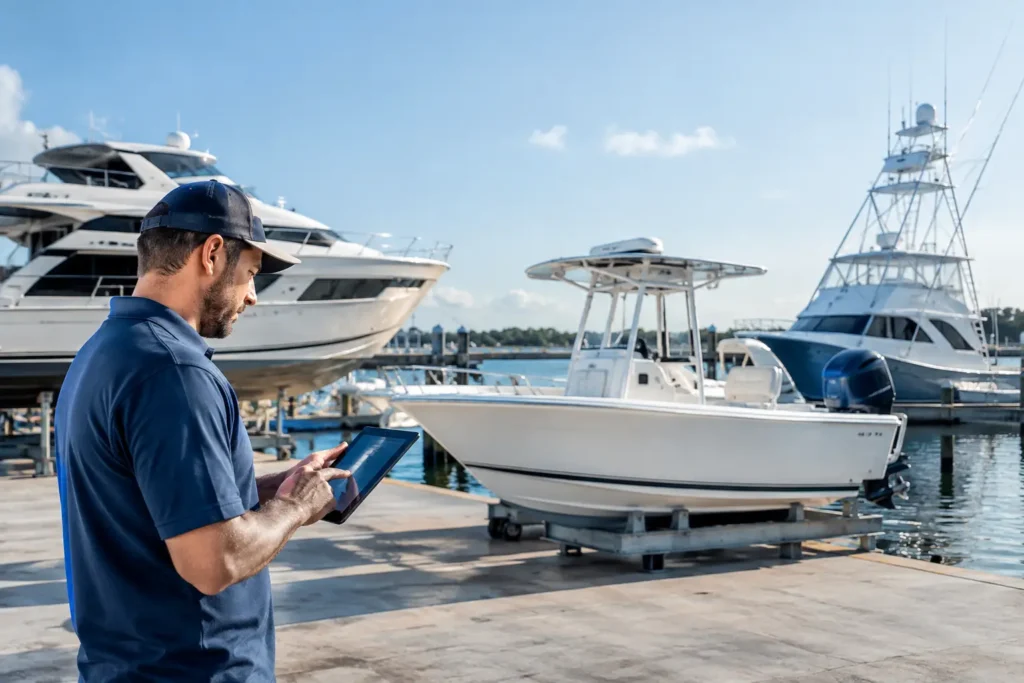
A missed haul-out window, a technician sent to the wrong slip, or a captain waiting on an update that lives in someone else’s text thread can derail an entire day. A useful marine scheduling platform review starts there: not with a polished calendar screen, but with whether the system holds up when the dock is busy, the weather changes, and three urgent jobs land at once.
Marine operations do not run like a standard office. Jobs move with tides, parts availability, access to the vessel, yard capacity, customer travel plans, and the simple fact that technicians work where Wi-Fi can be unreliable. The right platform gives the team a clear operating picture without forcing dockside work back into spreadsheets, paper tickets, and phone calls.
What a Marine Scheduling Platform Must Handle
Scheduling is not just assigning a person to a time slot. For a marine service business, it connects an approved estimate, vessel details, technician skills, labor time, parts, customer communication, and invoicing. For a marina or boatyard, it also has to account for slips, lifts, travel lifts, service bays, subcontractors, and work that cannot begin until the boat is physically accessible.
For yacht captains and crew, the scheduling problem looks different but carries the same pressure. Preventive maintenance, watchkeeping, inspections, guest trips, provisioning, crew rotations, and vendor visits all compete for limited time. A schedule that does not connect to equipment history and operational checklists can create a clean-looking calendar while hiding the work that actually matters.
That is why generic appointment software often falls short. It can book a slot, but it may not know the difference between a 40-foot center console with an outboard issue and a 145-foot yacht preparing for guests. Marine work needs vessel context attached to every decision.
Marine Scheduling Platform Review: The Criteria That Count
When evaluating a platform, look beyond the demo calendar. Ask a provider to show the full path from a customer request to a completed, billed job. If that path depends on duplicate entry, desktop-only steps, or side conversations outside the system, the calendar is not solving the operational problem.
Mobile use at the dock
A scheduler may work from an office, but technicians, captains, and crew work on docks, in engine rooms, and aboard vessels. They need to see their assignments, update job status, clock time, add notes, capture photos, and request parts without returning to a desk.
Test the mobile workflow with real conditions in mind. Can a technician use a phone to open a work order, see the vessel’s service history, record labor, and close out the work? Can they scan a barcode when pulling a part? Can a manager see that a job is delayed before the customer calls asking for an update?
A mobile-first system reduces the gap between work performed and work recorded. That matters because every gap becomes a billing dispute, a lost part, or a maintenance record nobody can find later.
Vessel records that follow the job
A good schedule should open directly into the vessel record. At minimum, that record should include Hull ID, make and model, engine details, equipment information, service history, open recommendations, documents, and customer contacts.
The benefit is practical. When a new technician is assigned to a recurring cooling issue, they should not have to search old invoices or call the service writer. They should see what was diagnosed last time, which parts were installed, and whether there is a related warranty concern.
For larger yacht operations, this connection is equally valuable. A planned maintenance item needs to point to the relevant machinery, procedures, manuals, and prior logs. Scheduling without records creates activity. Scheduling with records creates accountability.
Dispatch control without micromanagement
The best platforms let a dispatcher or service manager assign work based on location, availability, skill set, job priority, and expected duration. That does not mean every day will go according to plan. It means the team can make changes quickly without losing track of what moved and why.
Look for views that make sense for the operation: a daily technician board, a weekly service calendar, and a job-status view for the office. Color coding can help, but clarity matters more than color. Everyone should be able to tell which jobs are confirmed, underway, waiting on parts, waiting on customer approval, or ready to invoice.
Be cautious of systems that treat every appointment as fixed. Marine service work is often estimated, not guaranteed. A platform should support realistic time windows, job stages, and rescheduling without turning the calendar into a pile of overwritten notes.
Time tracking tied to billable work
Manual timecards are one of the quietest profit leaks in marine service. A technician may remember the work completed but forget 20 minutes of travel, testing, cleanup, or a second trip to the vessel. Multiply that across a crew and a month, and the margin disappears.
A practical platform makes time capture part of the job workflow. Technicians should be able to start and stop labor against the correct work order, identify travel or non-billable time where needed, and leave a clear service note before moving on. Managers should be able to review exceptions without chasing handwritten entries at the end of the week.
The trade-off is that time tracking must be easy enough to earn adoption. If entering time takes more effort than texting a supervisor, the team will work around it. Ask to see how few taps it takes on a phone, not just how detailed the reporting looks later.
Parts, inventory, and purchasing visibility
Scheduling becomes unreliable when the system does not know whether the needed impeller, filter, sensor, or oil is available. A job may appear ready on the calendar even though the crew is waiting on a part that was never ordered.
For businesses carrying inventory, the platform should connect parts usage to the work order and reduce stock accurately. Barcode-based workflows are especially useful when multiple technicians pull parts from trucks, bins, or a shop counter. The goal is not administrative perfection. It is knowing what was used, what needs replenishment, and what should be billed.
Not every operation needs a full warehouse system. A small mobile mechanic may need straightforward parts tracking and vendor ordering, while a boatyard with multiple departments may need deeper purchasing controls. Match the system to the real inventory burden, not to a feature checklist built for another industry.
Financial handoff that does not create a second job
A completed work order should not force the office to retype labor, parts, and customer details into accounting software. That delay slows invoicing and introduces errors. If your business uses QuickBooks, ask whether the integration is genuinely two-way and which records sync: customers, invoices, payments, items, taxes, and labor details.
Also ask what happens when something changes. Can an approved estimate become a scheduled job? Can a technician’s recorded time flow into the invoice review? Can the office catch missing signatures, notes, or parts before billing? These controls are less glamorous than a dashboard, but they protect cash flow.
Questions to Ask During a Demo
A provider should be able to answer operational questions clearly, not redirect everything to a generic feature tour. Bring one real job scenario to the demonstration, such as an engine diagnostic that requires a return visit after parts arrive, or a yard project involving several trades.
Ask them to show how the system handles the following:
- A customer calls to move a job because the boat is out of town.
- A technician discovers extra work and needs approval before proceeding.
- A part is consumed from inventory and must appear on the final invoice.
- A manager needs to know why a job missed its planned completion date.
- A customer asks for the vessel’s prior service records six months later.
The answers reveal whether the platform supports the whole workflow or only the first scheduling step. They also expose implementation realities. Some systems are powerful but require a dedicated administrator and months of cleanup. Others are easier to adopt but may not fit a complex, multi-location operation. Neither is automatically wrong. The right choice depends on the size of the team, job volume, and how disciplined the current processes are.
Where AI Can Actually Help
AI has a useful role when it removes data-entry friction instead of adding another screen for the team to manage. In a marine setting, that can mean turning a spoken technician note into a structured job update, extracting equipment information from a photo of an engine plate, or helping staff find prior service details quickly.
The test is simple: does it save a technician or manager time while improving the record? If the answer is no, it is a novelty. Yacht Logic approaches this from the water up, with AI tools designed around spoken requests, vessel data, maintenance work, and the reality that information is often captured dockside rather than at a desk.
AI should not replace experienced judgment. A captain still decides what is safe to defer. A technician still diagnoses the failure. But it can make their knowledge easier to document, schedule, and act on before the next service call.
Choose the System Your Team Will Actually Use
The strongest marine scheduling platform is not necessarily the one with the longest feature list. It is the one your dispatcher trusts at 7 a.m., your technician can update with greasy hands at the dock, and your customer service team can rely on when a boat owner asks for an answer.
Start with one recurring workflow that currently causes rework, missed billing, or customer frustration. Run that workflow through the platform during the evaluation. If the system makes the next job clearer, the records stronger, and the handoff faster, it is built for the work you do. That is a better signal than any calendar screenshot.