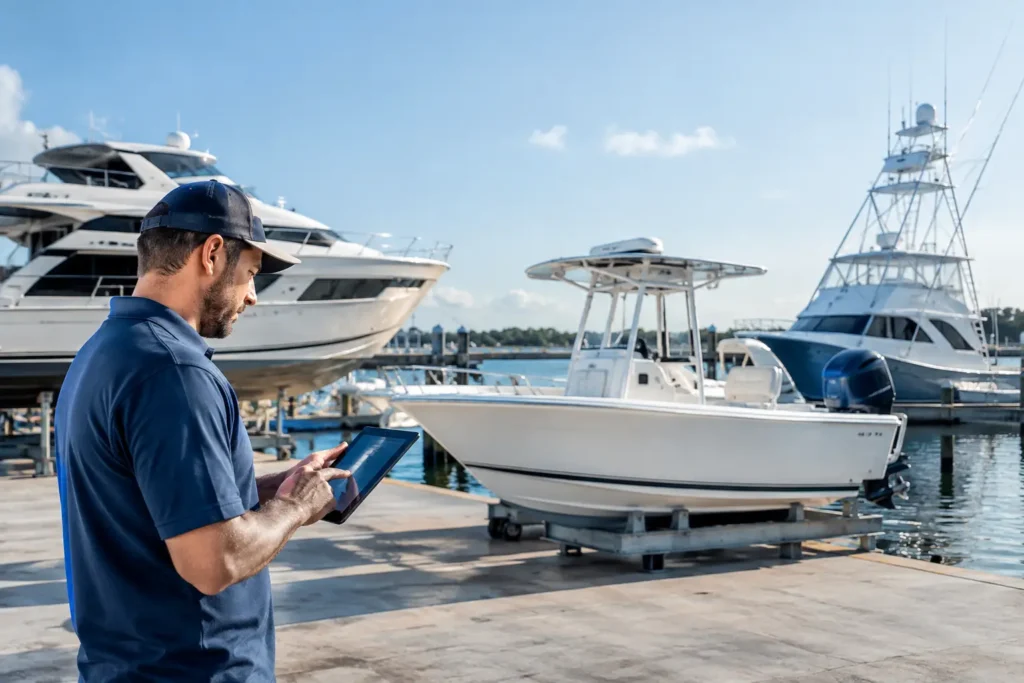
A bilge pump does not care that you meant to check it last month. Neither does an impeller, a battery bank, or the raw-water side of an engine that sat through a hot Florida summer. When you create boat service reminders properly, you replace memory and scattered paperwork with a maintenance plan that follows the way your boat is actually used.
That matters whether you run a 22-foot center console on weekends or manage a yacht with generators, stabilizers, tenders, and a full crew. The goal is not to fill your phone with alerts. It is to get the right work done before a minor service item turns into a lost weekend, an expensive tow, or a preventable failure underway.
Start With the Equipment That Can Stop the Boat
Not every maintenance task deserves the same priority. Start with systems that affect propulsion, safety, and your ability to get home: engines, drives, fuel systems, batteries, bilge pumps, steering, navigation equipment, and fire suppression.
For each system, identify the service task, its trigger, and the proof that it was completed. “Service engine” is too vague to be useful six months from now. “Change port engine oil and filter at 100 hours or annually, whichever comes first” gives you an actionable reminder and a clean service record.
A good reminder should answer three questions before you open it: what needs attention, when is it due, and what information or parts will be needed? Include the engine model, generator serial number, filter part number, fluid specification, or supplier details when you have them. That extra minute of setup saves time when the boat is at the dock and someone is trying to source parts on a Friday afternoon.
Build a baseline from manuals and service history
Manufacturer schedules are the starting point, not the entire maintenance plan. Pull the recommendations from engine, generator, outboard, battery charger, electronics, air-conditioning, and safety-equipment manuals. Then compare them with actual service invoices and engine-hour records.
If you bought a used boat with incomplete documentation, do not assume the last owner handled everything. Set a baseline inspection and record what you can verify. An oil sample, belt inspection, battery test, impeller check, and fluid review can establish a defensible starting point. From there, your reminders will be based on known work rather than hopeful assumptions.
Create Boat Service Reminders Using More Than One Trigger
Calendar-only reminders are easy, but they can miss the realities of boating. A vessel that runs 250 hours in four months needs different attention than one that runs 40 hours all year. The strongest maintenance schedule combines time, usage, and condition.
Use hour-based reminders for engines, generators, outboards, drives, and other equipment with operating meters. Oil changes, fuel-filter service, valve inspections, and generator maintenance often belong here. If an item is due every 100 hours, set an early warning at 85 or 90 hours. That gives you time to plan the work before the threshold arrives in the middle of a trip.
Use date-based reminders for equipment that ages whether the boat runs or not. Examples include annual fire extinguisher inspections, life raft service, registration renewals, insurance paperwork, emergency-positioning beacon battery dates, and seasonal commissioning or layup tasks. Battery maintenance and corrosion checks also belong on a calendar, especially in humid saltwater environments.
Condition-based reminders are just as useful. Create follow-up tasks after an unusual event: an overheat alarm, a grounding, water in a fuel separator, a lightning strike nearby, a heavy-weather passage, or a long period away from the boat. A fixed schedule cannot predict every issue. A good operating habit can.
Separate Pre-Departure Checks From Service Intervals
A reminder system fails when routine inspections get buried beneath larger jobs. Your pre-departure checks should be quick, repeatable, and separate from longer service tasks.
Before leaving the dock, confirm the bilge is dry or behaving as expected, check battery voltage, verify navigation lights, inspect fluid levels where accessible, review weather and fuel range, and look for leaks, loose hoses, or unusual odors. On a larger vessel, assign responsibility by department so the engineer, deck team, and bridge are not assuming someone else handled it.
These checks are not replacements for scheduled maintenance. They are early-warning tools. The captain or owner who notices a small coolant loss before departure has options. The one who notices it after an alarm at speed has a problem.
For recurring checks, keep the language specific. “Inspect engine room” is weak. “Check seawater strainers, belt dust, fluid leaks, bilge level, battery charger status, and engine-room fire system gauge” is clear enough for another crew member or technician to perform consistently.
Match the Reminder to the Person Who Owns the Work
A reminder without an owner is often just a notification that everyone ignores. Assign each task to a person, role, or service provider. On a privately owned boat, that may be the owner or a trusted mechanic. In a marine service business, it might be a dispatcher creating the job, a technician completing the inspection, and an office manager confirming the invoice and parts used.
For yacht operations, ownership should be even more defined. The captain may need visibility into compliance and readiness, while the engineer owns machinery intervals and the chief officer owns safety equipment. A task can have multiple people involved, but one person should be accountable for closing it out.
Set escalation rules for overdue work. A low-priority cosmetic task can wait. A missed generator service before a charter, an expired safety inspection, or a recurring fuel-system issue needs immediate attention. This is where priorities matter more than a long list of reminders.
Record Completion Like You May Need to Prove It
A checkbox alone does not tell the full story. When a service task is complete, record the date, engine hours, work performed, parts used, cost, technician, and any follow-up findings. Attach photos of worn components, receipts, test results, and invoices when practical.
Those records become valuable in ways that are easy to underestimate. They help diagnose repeat problems, support warranty discussions, protect resale value, and give a new captain, crew member, or service technician a clear picture of the vessel. They also show the true cost of ownership. A boat that appears inexpensive to maintain can look very different once labor, consumables, haul-outs, and recurring repairs are in one place.
This is where a boat-management app earns its place. Yacht Logic Connect can centralize boat records and maintenance costs while keeping service reminders tied to the vessel, not buried in a personal calendar or text thread. The useful result is operational control: you can see what is due, what was done, and what it cost without sorting through years of emails.
Avoid Reminder Overload
More reminders do not automatically produce better maintenance. If every minor task generates repeated alerts, people start swiping them away. Keep reminders meaningful and use lead times that match the job.
An oil change may need a 10-hour or 30-day warning. A haul-out or annual yard period may need reminders at 90, 60, and 30 days because yard availability, parts, and contractor schedules require planning. A service reminder for a life jacket inspection may only need one seasonal prompt.
Review your schedule after the first season. Did an interval prove too frequent for your operating profile? Did an item get missed because it was assigned to the wrong person? Did a service task require parts that should have been stocked aboard? Adjust the system to match real use, but do not stretch manufacturer intervals simply because the boat seems to be running fine.
Use seasonal triggers for your cruising area
Seasonal planning is especially useful for boats that move between regions or sit through part of the year. Before hurricane season, review dock lines, bilge pumps, batteries, insurance documents, and storm-preparation procedures. Before a northern layup, plan winterization, fuel stabilization, moisture control, and battery care. Before spring launch, schedule recommissioning, safety checks, and a sea trial.
For year-round boating areas, the seasons are different but still real. Heat, humidity, UV exposure, marine growth, and frequent use can accelerate wear. Set reminders around the conditions your boat faces, not a generic calendar copied from another owner.
Make the Schedule Useful at the Dock
The best reminder is one that turns into completed work with minimal back-and-forth. Keep vessel details accessible, use consistent equipment names, and make sure hours can be updated from the dock. If you use a service provider, share the relevant task details instead of relying on a verbal description of “the thing under the aft hatch.”
Start small if your records are scattered. Add the next oil service, the next safety-equipment review, battery checks, and the upcoming annual work first. Then build out the remaining systems as you verify documentation. A maintenance plan does not need to be perfect on day one. It needs to be trusted, kept current, and useful when the boat needs attention.
A well-timed reminder will never make marine maintenance glamorous. It will, however, give you more confidence when you turn the key, cast off the lines, and head beyond the markers.