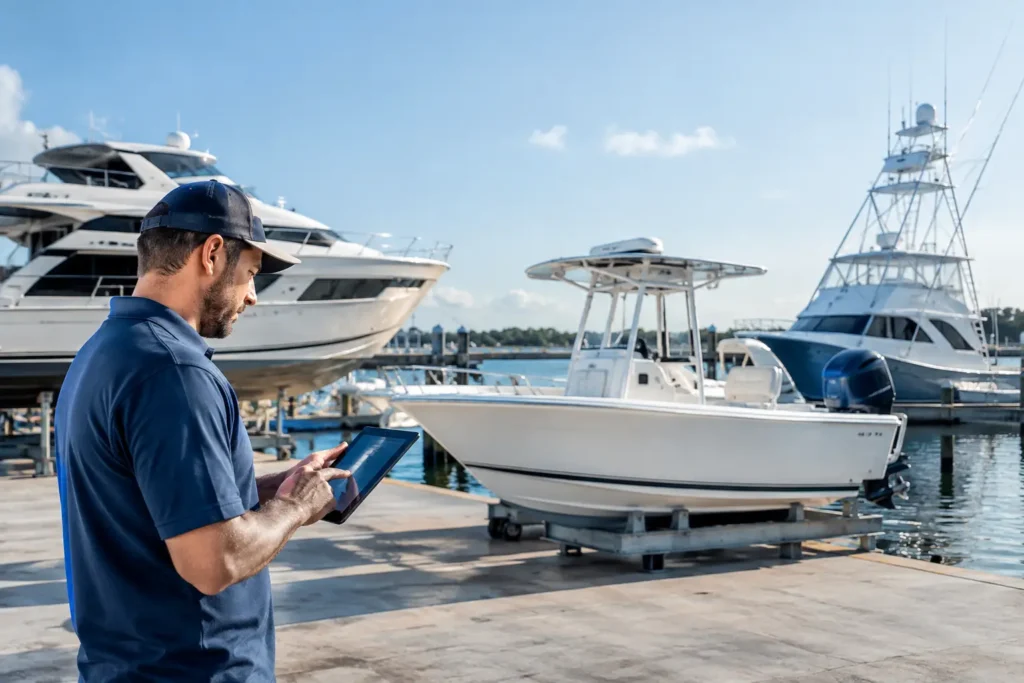
A failed bilge pump does not care whether its last service date is buried in a binder, a text thread, or someone’s memory. Neither does a customer waiting for an estimate, a captain preparing for a guest trip, or an owner trying to understand why maintenance costs jumped this season. Good boat software puts the information and actions that matter in the hands of the person standing on the dock, in the engine room, or at the helm.
That is the standard. Not another login that creates more data entry. Not office software with a marine logo added later. The right system should reduce the loose ends that create delays, missed maintenance, disputed invoices, and expensive surprises.
What Boat Software Should Actually Do
Boating operations are rarely linear. A technician finds a corroded connector while tracing a fault. A captain notices a recurring alarm during watch. An owner receives a service recommendation and wants to see the history before approving work. Each moment starts with incomplete information, often in a wet, noisy place with limited time.
Boat software earns its place when it captures that moment quickly and turns it into a usable record. A photo of an engine plate should help identify the asset. A spoken note should become a work item, not a forgotten voice memo. A completed job should carry the labor, parts, findings, and customer approval needed to close it properly.
For recreational owners, that usually means one place for vessel documents, maintenance history, costs, weather, tides, and service contacts. The benefit is straightforward: Your Boat. Your Records. Your Control. When it is time to sell, insure, troubleshoot, or schedule service, organized records stop being a nice idea and become leverage.
For marine businesses, the requirements go further. They need job intake, estimates, technician time, parts, inventory, invoices, customer communication, and accounting records to reflect the same job. For captains and crew, the system has to support recurring checks, watchkeeping, fuel logs, guest preferences, safety documentation, and handoffs between people who may not work the same schedule.
The Difference Between Marine Software and Desk Software
Many general business platforms can track a customer, issue an invoice, or store a file. That does not make them useful at a boatyard. Marine work has vessel-specific equipment, changing access conditions, intermittent connectivity, saltwater exposure, and jobs that expand when the first panel comes off.
A practical platform recognizes the difference between a generic asset and a vessel with a Hull ID, engine serial numbers, maintenance intervals, installed equipment, and a history that follows it from one service event to the next. It also recognizes that a technician cannot stop mid-job to return to a desk and reconstruct the workday.
Mobile-first workflows matter because the work happens away from the office. Technicians should be able to start a timer at the vessel, add labor as conditions change, scan a barcode for a part, attach photos, and record findings before moving to the next job. Captains should be able to complete a checklist on board rather than copy notes into a spreadsheet later that night.
There is a trade-off here. A platform built for every industry may offer a broad catalog of features, but it often requires costly workarounds to fit marine operations. A narrowly focused tool may be faster for a specific task but leave data stranded across separate apps. The better choice depends on how much of your operation needs to connect, from the first service request to the final invoice and future maintenance reminder.
How to Choose Boat Software for Your Operation
Start with the breakdowns you deal with every week, not a feature checklist. If service requests arrive through calls, texts, and handwritten notes, job creation and communication should be the first test. If parts disappear from shelves or get charged inconsistently, inventory traceability deserves priority. If end-of-month reconciliation is painful, accounting integration should be near the top of the list.
Then test the software in the conditions where your team actually works. Ask whether a technician can create or update a job with one hand while standing beside an open hatch. Check whether photos, serial numbers, and customer approvals stay attached to the correct vessel. Find out what happens when an estimate changes after inspection, or when a job requires a part that is not currently in stock.
Four questions separate a useful system from a polished demo:
- Can a vessel record hold the documents, service history, equipment details, and notes your team needs without hunting through folders?
- Can a technician track time, parts, photos, and findings from a phone at the job site?
- Can the office see job progress, labor cost, inventory movement, and customer approvals without re-entering information?
- Can your records move cleanly into accounting, including two-way QuickBooks synchronization when that is part of your process?
Do not overlook adoption. The best feature set on paper fails if captains, technicians, and office staff avoid it. Ask the people doing the work to run a real job through the system. A crew member should test a watchkeeping or maintenance task. A service writer should build an estimate. A technician should close a work order. Their friction points will tell you more than a sales presentation.
Build the Record Once, Then Keep Using It
The most valuable boat record is not a static file. It is a working history that becomes more useful after every service visit, inspection, fuel entry, and equipment update.
Consider a generator issue. A customer reports that it starts but will not carry load. The service team creates a job tied to the specific vessel and generator. The technician logs time, adds diagnostic photos, records the failed component, and captures the replacement part. The office can turn that information into an invoice without decoding a handwritten note. Months later, if the same problem returns, the history is already there.
The same principle applies to private ownership. A boat owner who stores receipts, manuals, warranty documents, maintenance events, and expenses in one vessel record can make better decisions. Is that recurring repair really new? Is the service interval due? What did the last haul-out cost? A clear history replaces guesswork with facts.
This is also where connected ecosystems have an advantage. Owners need trusted service providers. Service providers need complete vessel information before arriving. Captains and crew need maintenance records that do not disappear when personnel change. When each group works from disconnected tools, someone has to bridge the gap manually. Usually, that person is already busy.
Where AI Helps – and Where It Does Not
AI should reduce administrative drag, not add another task to manage. The useful applications are concrete: turning a spoken service request into a structured job, extracting details from a document, identifying relevant equipment information from a photo, or helping a technician organize symptoms before beginning diagnosis.
That can save meaningful time, especially for teams handling a high volume of service work. It also improves consistency. Instead of every technician describing a problem differently, the system can guide the information needed for a complete job record.
AI is not a replacement for a qualified marine technician, a captain’s judgment, or a proper inspection. It cannot see corrosion hidden behind a panel or take responsibility for a safety decision. Treat it as an operational assistant that handles the paperwork around the work, giving experienced people more time for the work itself.
Built from the water up, Yacht Logic is designed around that practical standard: help boaters, service teams, and yacht crews turn the information already moving through their day into organized action.
Start With the Next Job, Not a Perfect Migration
Teams often delay new boat software because years of records feel overwhelming. There is no need to stop operations while every old invoice, manual, and service note is cleaned up. Start with active vessels, open jobs, recurring maintenance, and the documents people request most often. Build the habit around today’s work, then bring in older records where they add value.
Choose one workflow to improve first. It may be technician time tracking, maintenance records, inventory scanning, or job approvals. Once the team sees fewer missed details and less duplicate entry, expanding the system becomes easier.
The goal is not to put more technology between people and the water. It is to make sure the right detail is available when a decision has to be made – before a small loose end becomes a lost day on the water.